How VALORANT Champions Shanghai group stage reshaped the 2026 title race
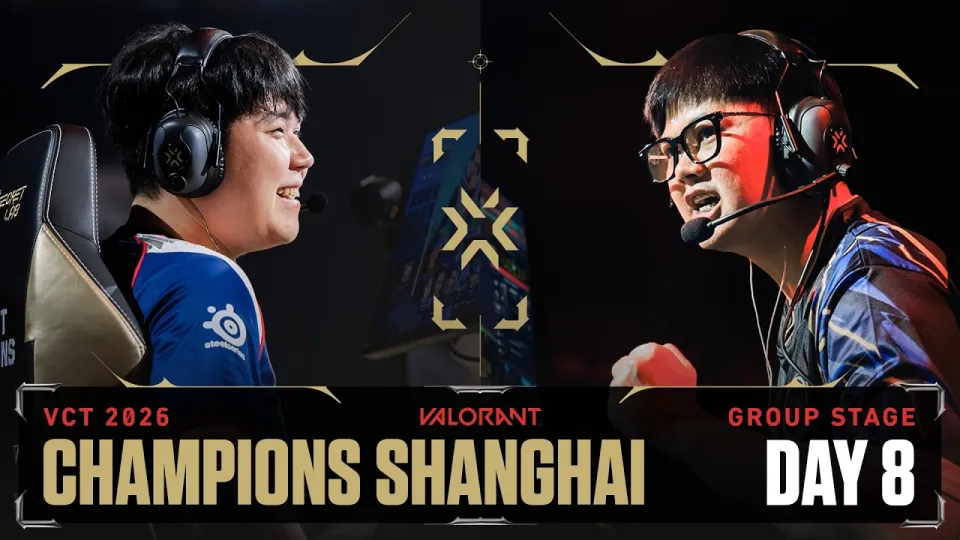
Video: VALORANT Champions Shanghai — Group Stage — Day 8
Want articles like this for your own video to promote it on YouTube and Google? Order them through the Telegram bot @sat_sit_bot. The bot writes and publishes the articles itself (with your YouTube video embedded) on popular topical websites (no ads). Your first 50 articles are free.
· based on the channel VALORANT Champions Tour
Key takeaways
- VALORANT Champions Shanghai runs September 24 to October 18 with 16 teams from Americas, CN, EMEA and Pacific.
- Day 8 of the group stage featured T1 vs JD Gaming, a three-map series decided in the final map.
- All four Chinese teams were eliminated in the group stage, ending the host region's run.
- JDG held a 6-11 lead on map one and lost it, a collapse viewers called the turning point of their tournament.
- Masters 2026 produced two different champions, and Shanghai is the first event to settle the year outright.
VALORANT Champions Shanghai is the 2026 world championship, a 16-team tournament running from September 24 to October 18 that gathers the best rosters from Americas, CN, EMEA and Pacific to crown a single world champion. The group stage closed with all four Chinese teams eliminated, T1 beating JD Gaming in a three-map series on Day 8, and a bracket that suddenly looks far more open than the pre-event seeding suggested. Official updates, bracket news and schedule changes are posted through the VALORANT Esports channels, starting with the official VALORANT Esports X account.
What the VALORANT Champions Shanghai format actually demands
Sixteen teams, four regions, one trophy: the format is built so that no roster can hide behind a single good map. Teams arrive from Americas, CN, EMEA and Pacific, and the group stage forces cross-region matchups immediately, which is why regional form has translated so unevenly. A team that dominates its own league can still be punished by a playstyle it has never practiced against, and that gap is exactly what the Shanghai group stage exposed.
The event is produced by the VALORANT Champions Tour, and the Day 8 broadcast is the clearest single document of how the group stage was decided. Sponsors attached to the 2026 season include AWS, Coinbase, EWC, ENC, Globant, HyperX, Mastercard, OnePlus, Red Bull, Secretlab and Verizon, which matters less for gameplay and more for scale: this is a tier-one production with full observer coverage, replays and analyst desks.
Why the host region went 0-for-4 in the group stage
Every Chinese representative was eliminated before the playoff bracket, a result that turned the home crowd into the story of the week. The venue atmosphere drew jokes about playing in a library, but the more useful read is competitive: CN teams were not short on mechanics, they were short on reps against the specific tempo that Americas and Pacific rosters bring to international play.
One widely repeated argument is that the region's slots came too easily and that CN should fold back into a broader APAC pool to raise the weekly difficulty. That is a structural debate, not a Day 8 result, but the group stage gave it ammunition. The counterpoint is equally real: JD Gaming pushed a top-tier opponent to a deciding map, which no CN team had managed at this stage before.
JD Gaming's 6-11 lead and the map that got away
The single most discussed moment of Day 8 was JD Gaming's map one, where the team built a 6-11 lead and then lost control of the map entirely. Closing that map would have put the series at 2-0 in their favor, an outcome almost unheard of for a CN roster on the global stage, and it would have changed the entire shape of the group.
Instead, the series went the distance. JDG's third map collapsed, and observers were blunt that the team simply ran out of answers once the opponent adjusted. The pattern is familiar in VALORANT: a lead built on confident early-round calls becomes fragile the moment the opponent starts trading space instead of duels.
T1's series and the small decisions that decided it
T1 won the series, but the broadcast left plenty of room for argument. The most visible talking point was a Crown that got silenced at a critical moment, which several viewers described as the most satisfying sequence of the match, and a round where a headshot registered as a body shot on Omen, prompting questions about hit registration and server-side confirmation.
There was also a genuine tactical curiosity: T1 fielded Munchkin on a duelist, a role swap that raised eyebrows and, depending on the round, either looked like a masterstroke or a liability. Add a lengthy technical pause during game one and a mid-broadcast moment where a player appeared to be learning lineups live, and you get a series that was as messy as it was decisive.
The Masters 2026 context behind the Shanghai bracket
Two different teams won Masters events during the 2026 season, which is the single most important fact for reading this bracket. When the same roster keeps winning, the meta is solved and everyone else is chasing. When two different teams win, the field is genuinely open, and a group stage can eliminate a favorite without it being a scandal.
That context is why the Day 8 results read as a shift rather than an upset. New contenders have arrived, expectations built on earlier in the season no longer hold, and the phrase regional curse has become a punchline because the teams playing at home simply were not ready for the level of the field.
What to watch in the Shanghai playoffs
The playoff bracket rewards teams that can lose a map and adapt, not teams that peak once. Three things decide who lifts the trophy from here:
- Map pool depth. A roster that can only win on two maps gets banned out in a best-of-five.
- Mid-series adjustments. JDG's collapse showed what happens when the first plan stops working and no second plan exists.
- Utility discipline. Silenced ultimates, wasted smokes and late rotates cost more rounds at this level than missed shots.
For viewers following along, the official channels remain the fastest source for schedule changes and bracket updates.
Useful links
- VALORANT Esports on X
- VALORANT Esports on Facebook
- VALORANT Esports on Instagram
- VALORANT Esports on TikTok
- VALORANT on Twitch
What Shanghai tells us about the rest of the season
The group stage did what a good group stage should: it removed the assumption that seeding equals strength and left the bracket genuinely unpredictable. Four host-region teams are gone, a near-upset became the tournament's defining what-if, and the remaining field is wide open in a way that two different Masters champions already hinted at. The Day 8 broadcast from the VALORANT Champions Tour is the best single record of that shift, from the technical pause to the final map. Follow the official VALORANT Esports X account for the playoff schedule and every bracket update as Shanghai moves toward its conclusion.
Source: VALORANT Champions Shanghai — Group Stage — Day 8 · Markdown version
Questions & answers
How many teams play at VALORANT Champions Shanghai?
Sixteen teams qualify from four regions: Americas, CN, EMEA and Pacific. The event runs from September 24 to October 18, starting with a group stage and finishing with a single-elimination playoff bracket that decides the 2026 world champion.
Why were all the Chinese teams eliminated in the group stage?
The short answer is preparation, not talent. CN rosters had limited practice against the tempo and utility-heavy defaults that Americas and Pacific teams bring internationally, and the group stage forces those cross-region matchups immediately. JD Gaming came closest, holding a 6-11 lead on map one before losing the series in three maps.
What happened in the T1 vs JD Gaming series on Day 8?
T1 won in three maps, but the series was defined by JD Gaming losing a 6-11 lead on the opening map, which would have put them 2-0 up. T1 also fielded Munchkin on a duelist, and the broadcast included a long technical pause plus a round where a headshot appeared to register as a body shot on Omen.
Does the Shanghai result mean CN should merge back into APAC?
That is the loudest argument in the community, and it has a real counterpoint. Easier regional slots can slow development, but merging back into APAC would not by itself fix the practice-quality gap. JD Gaming's near-upset suggests the region is closer than a 0-for-4 record implies.